Most beds sold for big dogs are mats with a marketing budget. I say that as someone who has measured the foam in more than 60 of them. A golden retriever bed setup comes down to three numbers: the length of your dog stretched out, the thickness and density of the foam, and the number of days the bed holds its shape before it pancakes. Get those three right and everything else is decoration.
I run this site from Colorado with two goldens, Biscuit at 95 pounds and Maple at 60. Biscuit destroys things. Maple has sensitive skin. Between them they have flattened, shredded, and outlived enough beds that I keep a notebook of real measurements instead of trusting product photos of puppies sitting on beds built for puppies.
Here is the whole process, in the order I do it.
Why you should trust me
I spent eight years as a vet tech before I started writing about dog beds full time, so I look at hips and elbows before I look at fabric. I have tested more than 60 beds over 10 years, and I keep a notebook with dates and numbers: foam thickness the day a bed arrives, sink depth under weight, weight after washing, months until the cover fails. When I say a bed flattened, I mean I measured it. When I say a cover survived, I mean it went through my machine.
Two rules I do not break. The cover has to come off and go in a washing machine, because a golden sheds year round and a bed you cannot wash is a bed you will throw away. And a bed has to survive two years with a 90 pound dog, because below that it is a toy, not a bed.
What a golden retriever actually needs from a bed
Golden retrievers are one of the breeds where hip and elbow problems are common enough that your vet is already watching for them. I am not going to give medical advice, and you should talk to your vet about your dog. But the sleeping surface is something you control, and it matters.
The floor for a full grown golden is 4 inches of dense foam. Foam density is measured in pounds per cubic foot. Three to four pounds per cubic foot is a real support foam. One and a half to two pounds is packaging material with a nicer name. A listing that says "orthopedic" and shows a 2 inch pad is not selling you an orthopedic bed, it is selling you a mat with big letters on the box.
Beyond the foam, you need three things:
- A cover that unzips and goes in the machine. Not spot clean only.
- A size that fits the dog sprawled out, not curled up. Goldens sleep on their sides with legs out more often than people expect.
- A base that does not slide across hardwood when a 95 pound dog flops onto it.
If the bed lives in a crate, add a fourth: the pad has to fit the crate tray with no gaps at the corners, because dogs work at gaps.
How to measure before you order
This takes five minutes and saves you a return.
Step one: measure your dog, not your dog's photo. Wait until your golden is sprawled flat on the floor, then measure from the tip of the nose to the base of the tail. Add 8 to 12 inches so there is room to stretch. A 95 pound male golden sprawled out is a long animal. Beds get returned because owners measured the curled up dog.
Step two: measure the crate interior. Measure the tray, not the outside of the crate. Subtract an inch for the door hardware and the frame. Write the number down.
Step three: check the floor space where the bed will actually sit. Not where you want it to sit. Biscuit's base of operations is a corner of the living room, and the bed that fits there is smaller than the bed that fits in the garage.
Step four: read the spec sheet for foam thickness and density. If neither number is listed, assume 2 inches of low density foam and keep scrolling.
Step five: find the zipper. Look at the photos. If you cannot see a zipper on the cover, the cover does not come off.
The two beds below cover the two jobs a golden actually has: a pad for the crate and a soft bed for the floor.
Two beds for the two jobs
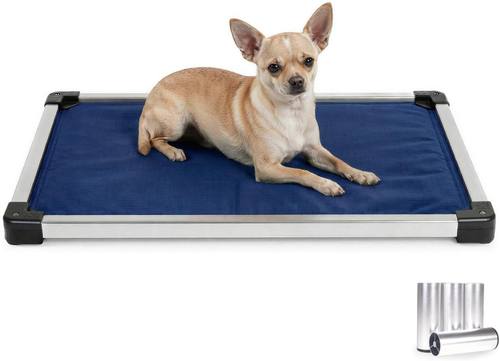
The crate pad: K9 Chew Proof Armored Padded Dog Crate Bed, S, Blue Quartz
 Visit on Amazon →
This is the one I point at when a golden is still in the chewing stage. The build is the whole point: an armored, chew resistant surface over padding, which is a different animal from the soft fleece pads that a bored dog opens up in an afternoon. If your golden has already turned one crate pad into a pile of fluff, this is the category to shop in.
Read the size before you order. This listing is the small, so it suits a puppy crate, a car crate, or a small dog's crate, not a 42 inch crate built for an adult golden. Measure the tray first. A pad that is too small leaves gaps at the corners, and dogs chew at gaps.
Flaws but not dealbreakers: An armored surface is not a cloud. It is firmer and less plush than a faux fur bed, and some dogs take a week to accept it. That is the trade for a pad that is still in one piece at month six.
The right buyer is someone with a golden puppy or a dog that has already destroyed a softer pad, and a crate tray that matches the small size.
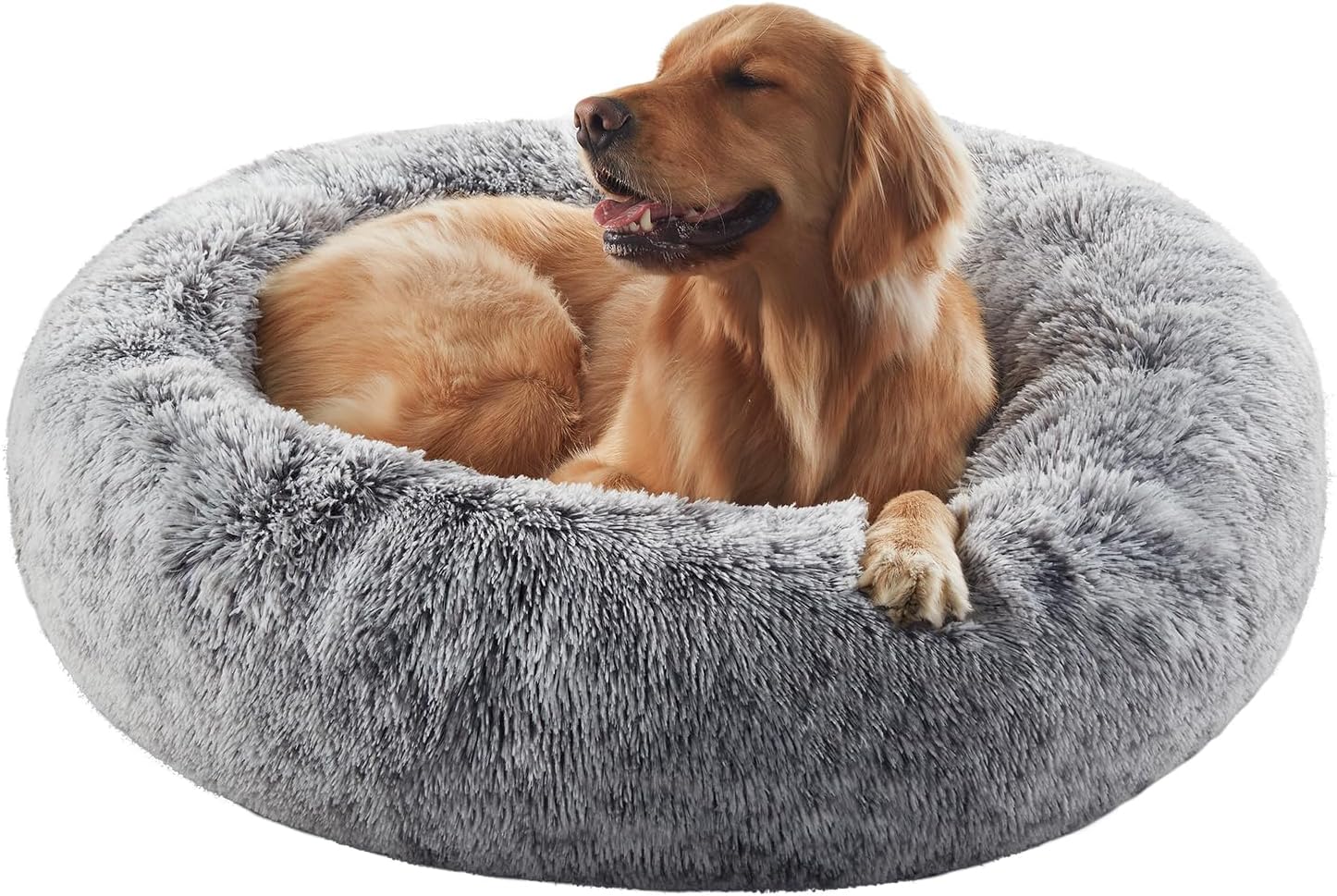
The floor bed: 36 inches Faux Fur Fluffy Donut Dog Bed for Large Dogs, Dark Grey
 Visit on Amazon →
This is a lounging bed, and I want to be straight about that. A donut bed with a raised rim is great for a dog that curls, and the 36 inch size suits a golden in the 60 pound range, which is Maple's weight class. The faux fur surface is why dogs pick it, and it is also why I would look twice if your golden has skin issues, because some dogs run hot on synthetics. Maple has sensitive skin, so I watch her for a week on any new fabric.
The honest caveat: a donut bed has no dense foam base to speak of. It is a soft nest, not a support bed. A 95 pound golden who sprawls will compress the rim and the middle into a pancake over time, and once a donut pancakes there is nothing left to fix. If your golden is Biscuit's size and sleeps flat on his side, this is a second bed, not the main one.
Before you buy, confirm two things on the listing: that the cover zips off for washing, and that the base has something to stop it sliding. A faux fur bed that cannot be washed is a faux fur bed that smells like wet dog by February.
Flaws but not dealbreakers: Faux fur collects hair and holds onto it. Vacuum it before every wash or you will be pulling golden hair out of your machine filter for a month.
The right buyer is a golden in the 50 to 70 pound range who curls up to sleep, in a house where the bed sits on carpet or a rug.
How to set up the bed so it lasts
Let the foam breathe. Beds ship compressed. Give the bed 24 to 48 hours in a warm room before you judge the thickness. Measure it after it expands and write that number down. It is your baseline, and in six months you measure again and know whether the foam is holding.
Put it where the dog already sleeps. Not where you want the dog to sleep. Dogs pick a base of operations and then defend it. A bed placed in the spot your golden already claims gets used on day one. A bed placed in a hallway you like gets ignored.
Rotate it every month. Flip the bed or turn it end to end so the same spot does not take all the weight. It takes 30 seconds, and it is the difference between even compression and a permanent dip where your dog's hip lands.
Check the zipper monthly. Zippers fail before foam does. If the pull is separating or the teeth are spreading, fix it while the cover is still usable. A repairable bed is a keeper. A bed with a blown zipper and a good foam core is a bed you throw out for no reason.
Keep one bed per floor. Stairs are the enemy of a large dog's joints. If your golden sleeps upstairs and hangs out downstairs, one bed in each place means fewer trips up and down on hardwood.
How to wash the cover without ruining the bed
The cover is what fails first, and most of the time it fails because of how it was washed, not how often.
- Unzip the cover and take it off the foam. Never put the foam core in a machine. Water and agitation break foam down faster than a dog's weight does.
- Vacuum the cover before it goes in. Golden hair turns into a felted mat in the wash and then into a clog in your machine.
- Wash cold on a gentle cycle with a mild detergent. No bleach, no fabric softener. Softener coats the fibers and kills any water resistance the cover had.
- Air dry, or tumble on low with no heat if the tag allows it. Heat is what shrinks covers and delaminates waterproof backing.
- Spot clean between washes. A damp cloth on the surface every week buys you weeks between full washes.
Every two to four weeks is right for a golden that sleeps on the bed nightly, and immediately after any accident. A bed that smells like a dog is a bed the dog stops using, and a bed that stops being used gets replaced early.
Mistakes I see golden owners make
Buying for the puppy. If you have an 8 week old golden, buy a cheap pad now and plan to replace it. Spending real money on a bed for a dog whose adult weight you do not know yet is how people end up with a shredded expensive bed and a grown dog with nothing.
Trusting the word orthopedic. Two inches of soft foam is a mat. Ask for thickness and density, and if the listing will not give you both, that is your answer.
Buying a bed that is too small. The number one return reason. Measure the sprawled dog, not the curled dog.
Skipping the washable cover. This is my deal-breaker and it should be yours.
Assuming a donut bed is a support bed. It is a nest. Some goldens love them and some goldens flatten them. Know which dog you have.
What this costs, and the only math that matters
Sticker price is what marketing wants you to focus on. Cost per day is the honest number. Divide what you pay by the number of days the bed actually lasts. A cheap bed that dies in four months is not cheap. It is a subscription.
The donut bed here is the lower cost of the two. The armored crate pad is the higher cost, and it earns that by being the one that survives a dog that chews. If your golden is past the chewing stage and sleeps on the floor, the donut is the better use of money. If your golden is a puppy or a destroyer, spend on the pad and wait on the fluffy bed.
Two years of nightly use is the bar I hold every bed to. Run that math on any bed you are considering and the decision usually makes itself.
The short version
Measure your golden sprawled out and add a foot. Insist on 4 inches of dense foam for a support bed, and accept that a donut bed is a nest, not a support bed. Buy the armored pad if your dog chews, the fluffy donut if your dog curls and weighs under 70 pounds. Wash the cover cold, air dry it, rotate the bed monthly, and fix the zipper before it fails.
That is the whole golden retriever bed setup. The dog does the rest.