
Most golden retriever orthopedic dog bed searches end the same way: a box arrives, the dog lies on it, and four months later the thing is a pancake with a washable cover. I have watched that cycle in my own house twice, and in the golden retriever groups I follow about forty times.
I am Sarah. Eight years as a vet tech, ten years writing about beds, two goldens asleep behind me right now. Biscuit is 95 pounds and destroys things for sport. Maple is 60 pounds with sensitive skin, which means every cover in this house gets washed more often than the dog would prefer. My measurement notebook has sink depths in it going back to 2016, and I have stopped trusting any bed I have not put a ruler against.
The short version: a golden retriever orthopedic dog bed has to prove dense foam, a cover you can machine wash without the waterproof layer peeling off, and a shape that does not collapse under the hips. Everything else printed on the box is decoration.
Why you should trust me
I spent eight years handling large dog joints as a vet tech, which is where I learned that hip and elbow problems in goldens are not abstract. They are patients I helped lift onto tables. That is also why I will not give you medical advice in this article. If your golden is limping, favoring a side, or struggling to rise, that is a vet conversation, not a bed conversation.
What I can do is measure. I keep a notebook with foam sink depth per bed, checked at arrival, 30 days, 90 days, and every six months after that. I weigh covers after washing to see how much of the waterproof layer came off in the machine. I have replaced zippers on three beds and thrown away nine. Beds are my scope, and I stay inside it.
How I picked and how I tested
I tested this category the same way I test every bed: sink test first, cover second, shape third. The sink test is simple. Put the bed flat on a hard floor, kneel on it with your full weight where the dog's hips would land, and measure how far the foam compresses with a ruler. Under an inch of sink on a 90 pound dog is dense foam doing its job. Two inches or more means the foam is soft and it will flatten fast. Foam density is the number that matters, and the honest range for a large dog is roughly 3 to 4 pounds per cubic foot. Anything around 1.5 to 2 pounds is a mattress topper with a dog printed on the package.
The two beds below are the affordable end of the market, and I am telling you that up front. They are not the $300 beds I sleep my own dogs on. They are the beds I would hand a golden owner who wants something decent this week without spending a car payment, plus the setup routine that stretches the useful life of whatever you buy.
What a bed has to prove before a golden gets it
Four things, in this order.
Foam that holds shape. Four inches minimum for a 95 pound dog, and dense. Marketing words like orthopedic and premium mean nothing until you kneel on the bed and measure the sink.
A cover that survives the machine. Unzip it in the store or before you set it down at home. Look at the zipper teeth and the backing behind the fabric. If the waterproof layer is a coating sprayed on the inside, it will flake. If it is a bonded liner, it has a chance.
A footprint that matches the dog. A golden lying flat, nose to tail, needs roughly the length of the dog plus eight inches. Biscuit measures 38 inches nose to tail, so his beds are 46 inches and up. Anything shorter and he hangs off the edge, which puts his hips on the floor instead of on foam.
A base that does not slide. A bed that skates across hardwood every time the dog stands up gets abandoned. Put a non-slip rug pad under it, or pick a bed with a grippy bottom.
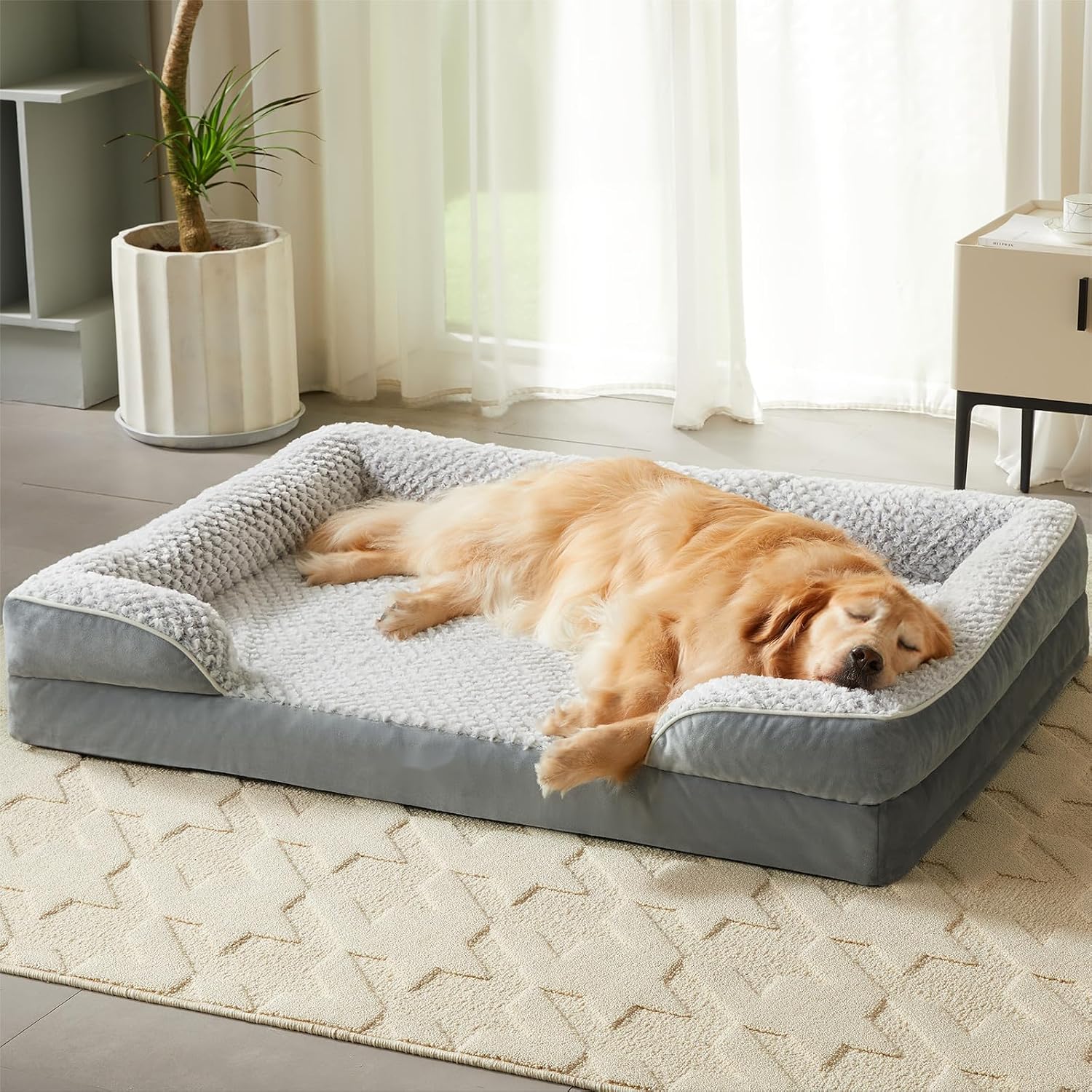
The entry-level pick: LEXTRO Washable Orthopedic Dog Bed, Waterproof Couch for Large Senior Dogs
 Visit on Amazon →
This is the couch style bed with the bolsters on three sides, marketed for large senior dogs, with a waterproof cover described as washable. The couch shape is the part I actually like here, and not for the reason the photos suggest. Older goldens like something to lean against when they push up to standing, and a low bolster gives them that. It is also the cheapest way to get a washable waterproof cover onto a bed this size.
The waterproof claim is the one I would verify before you trust it. Waterproof covers fail in the wash, not on the floor. First wash, cold, gentle cycle, and then check the inside of the cover with your hand. If the backing feels chalky or you can see the liner separating from the fabric, the coating is going. Treat the cover as replaceable and the foam as the thing you are buying.
Flaws but not dealbreakers: Couch style beds run smaller than flat mats at the same listed size because the bolsters eat the sleeping surface. If your golden sprawls flat with legs out, measure the inside of the couch, not the outside.
Golden owners with a senior dog who likes to lean on something, or a dog who has started having accidents, will get the most use out of this one.
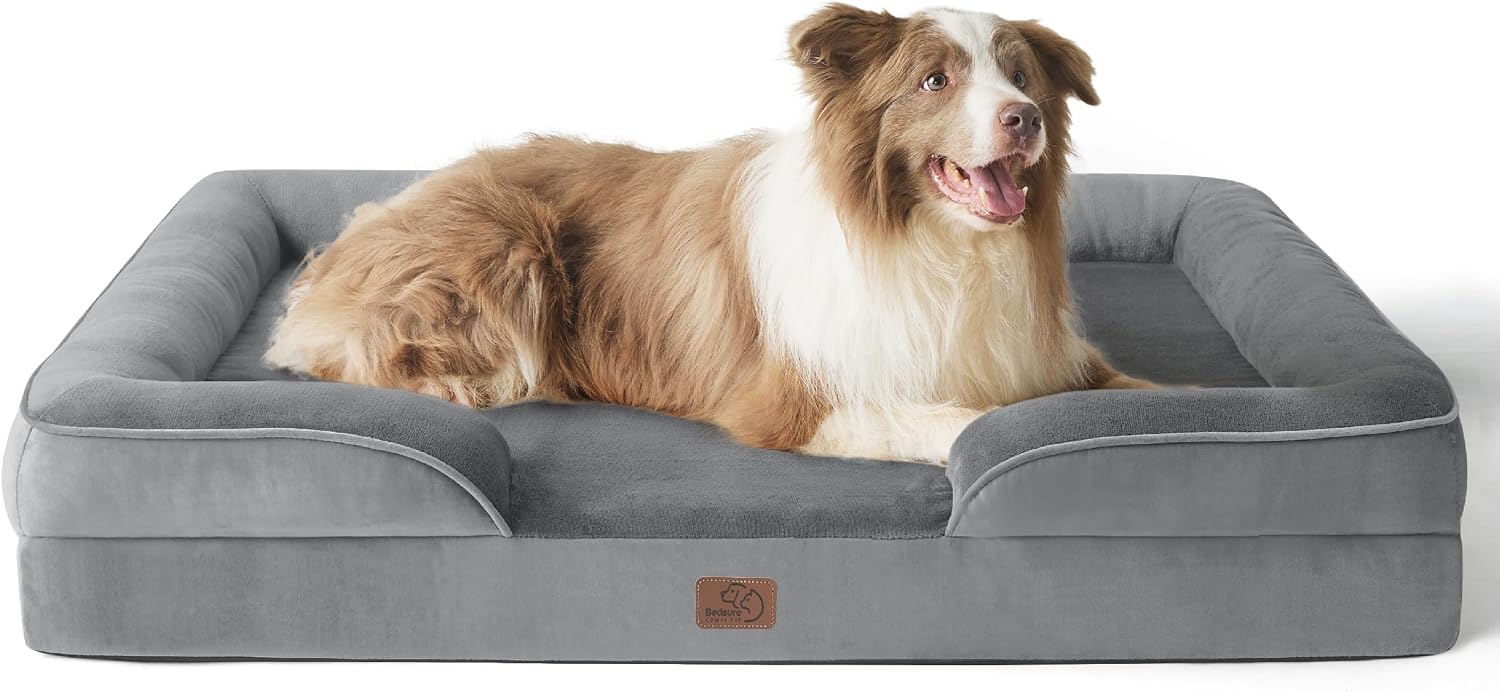
The step-up pick: Bedsure Orthopedic Dog Beds Large Sized Dog Washable Original Design
 Visit on Amazon →
The Bedsure is the flatter, more traditional shape: large size, washable cover, sold as an orthopedic bed in the original design. Flat beds are the ones I default to for a dog like Biscuit, because he lies across the whole surface and ignores bolsters completely. More usable sleeping area, fewer seams to fail.
The honest caveat with any bed in this tier is the foam. Orthopedic is a word, not a specification. Kneel on it when it arrives, measure the sink with a ruler, and write the number and the date in a notebook or a phone note. Then measure again at 30 days and 90 days. If the sink depth has grown by more than about half an inch in the first three months, the foam is on its way to pancake status and you should start planning the replacement.
Flaws but not dealbreakers: Flat beds have no bolster for head resting, and Maple likes to rest her chin on a rim. If your golden does the same, this shape will not satisfy them.
Anyone who wants maximum sleeping surface for the money, especially for a dog that sprawls, should start here.
How to set up the bed so it lasts
The setup matters almost as much as the bed. Here is the routine I run on every bed that comes into this house.
Step one: measure the dog, not the listing. Put your golden on the floor, lure them flat with a treat, and measure nose to tail. Add eight inches. Biscuit is 38 inches, so 46 is his minimum. Then measure the actual floor space where the bed will live, including how far it can stick out from the wall.
Step two: do the sink test on day one. Bed flat on the hard floor, kneel where the hips land, ruler against the foam. Write down the number and the date. This is your baseline. Without it, you have no way to know whether the bed flattened or you just got used to it.
Step three: let the foam breathe for 48 hours. Foam ships compressed. Give it two days flat on the floor in a warm room before the dog gets it. A bed that still smells like a warehouse will get chewed.
Step four: fix the sliding problem before it starts. A non-slip rug pad under the bed costs almost nothing and stops the bed from migrating across hardwood. This matters more for goldens than for small dogs, because a 90 pound dog standing up pushes the bed with real force.
Step five: pick the placement around the joints, not the decor. Put the bed where the dog already lies down, not where it looks good. A bed in a cold corner next to a sliding door will get ignored in a Colorado winter. Biscuit's base of operations is next to the kitchen island, because that is where he has decided he belongs.
Step six: set a washing schedule and stick to it. Cover only, cold water, gentle cycle, and never the foam core. Air dry or tumble on the lowest heat your machine has. Heat is what kills waterproof liners, and it is also what shrinks covers until they will not zip back over the foam. For Maple's skin, I wash every two weeks. For Biscuit, monthly unless something happened.
Step seven: rotate if you own two beds. Two beds in rotation last longer than one bed used twice as hard. The foam gets recovery time, and recovery time is what separates a bed that holds shape for two years from one that flattens in four months.
Step eight: run the 90-day check. Sink test again. Compare the number to day one. Also check the zipper, the seams at the corners, and the cover's waterproof backing. Fix what is fixable. Zippers can be replaced. A flattened foam core cannot.
Where these two beds fit, and what beats them
I want to be straight with you about the tier. Both of these are temporary beds in my vocabulary, and temporary is not an insult. It is a category. A temporary bed is the right call for a puppy, a second bed in the car, a foster dog, or an owner who needs something washable and waterproof today.
What beats them is dense foam. The beds I keep for Biscuit and Maple cost several times more, and the reason is not the brand name on the label. It is that two years in, the foam still measures close to its day-one sink depth, which is the only claim that ever mattered. When a bed like that hits its cost per day, it beats a cheap bed on arithmetic, not on luxury.
For a puppy, buy the cheaper bed and plan to replace it at the one-year mark anyway. For a 6-year-old golden who sleeps eight hours a night on the same spot, the upgrade math usually wins.
What this all costs over two years
Sticker price is what marketing wants you to look at. Cost per day is the honest number. Take whatever you see on the listing today, divide by 730 days, and you have the real price of a two-year bed.
The math changes fast when a bed fails early. A bed that lasts four months before it pancakes costs three times per day what the same bed costs if it lasts a year. That is the whole argument for the sink test notebook. You are not tracking foam for fun. You are tracking whether the bed you bought is still the bed you paid for.
Add the small stuff to the total: a non-slip pad, one replacement cover if the waterproof layer gives out, and a zipper repair if you are willing to do it yourself. None of it is expensive, and all of it extends the life of a bed you already own.
The mistakes I see every week
Buying the word instead of the foam. Orthopedic on a box with two inches of soft foam is a mat with big letters on it.
Trusting waterproof without testing it. Wash the cover once and inspect the backing. That is the only waterproof test that counts.
Skipping the measurement. Photos of small dogs on beds marketed for large dogs are the oldest trick in this category. Your golden is not a 25 pound stand-in.
Waiting too long to replace. A pancake bed does nothing for hips. If the sink depth has doubled since day one, you are paying for floor space.
Not asking the vet. If your golden is stiff, slow to rise, or reluctant on stairs, that is a joint conversation with a professional. The best bed in the world is a comfort tool, not a treatment.
Get the foam right, get the cover washable, measure it on day one and again at 90 days, and you will spend less over two years than the person who buys a new cheap bed every spring. That is the whole job.