Most golden retriever bed setup advice skips the part that actually costs you money, which is the chewing. You buy one big soft bed, the dog opens a corner seam in week three, and now you are shopping again. That is how a cheap bed stops being cheap.
I have two goldens, Biscuit at 95 pounds and Maple at 60, and I have kept a notebook on every bed that has come through this house for ten years. Sixty plus beds. Foam thickness the day it arrived, foam thickness six months later, what the cover looked like after the fifth wash, and how many days it lasted before I had to repair it or retire it.
What the notebook says is that a golden needs two beds, not one, and they do different jobs. A crate bed that survives teeth, and a floor bed that survives washing. Get the order right and you stop replacing beds every season.
Why you should trust me
I spent eight years as a vet tech before I started writing about gear full time, which means eight years of looking at hips and elbows on large breed dogs and hearing owners describe what their dog slept on. Then ten years of measuring beds in my own house in Colorado, with two goldens who are very good at finding weak points.
The notebook has real entries in it. Foam sink depth measured with a ruler every six months. Beds weighed before and after a wash cycle, because a cover that holds water is a cover that is going to smell. Cost per day for every bed that has come through here, which is the only price comparison I trust. Sticker price is what marketing wants you to look at.
What I do not do: I do not review food, medicine, or supplements. I was a vet tech, not a nutritionist. I also do not repeat a spec sheet as if I measured it. If a number shows up in this article, it is either a number I can point to in the notebook or a number you should measure yourself, and I will tell you which.
How I picked these beds and what I checked
This is not a list of the best beds for a full grown golden. It is the setup I would build for a golden who is still in the chewing phase, plus the rules for upgrading later, because those are two different purchases and mixing them up is how people waste money.
Every bed I look at gets the same checklist:
Chew resistance at the seam. Not the middle of the fabric, the corner where the cover meets the base. That is where a determined dog starts, and it is where most covers fail.
Cover off, machine wash, cover on. If the zipper jams or the fill clumps into a lump on one side, the bed is a return, not a keeper. A machine washable cover is a deal breaker for me. Cannot wash it, will not buy it.
Size honesty. I measure the crate floor inside, corner to corner, and I measure the dog flat on the ground. A crate pad is sized to the crate. A floor bed is sized to the dog. Those numbers are never the same as the label on the box.
Foam thickness against body weight. For a 95 pound golden, a floor bed needs 3 to 4 inches of dense foam to mean anything. Two inches of foam is not orthopedic, it is a mat with big letters on the box.
Cost per day. Price divided by the days it actually survives. That is the honest number.
The two beds below are both small format, and that is deliberate. In a golden retriever bed setup for a puppy or a young chewer, small and washable beats big and expensive, because the dog is going to outgrow the size and chew through the first version anyway.
The beds in this setup
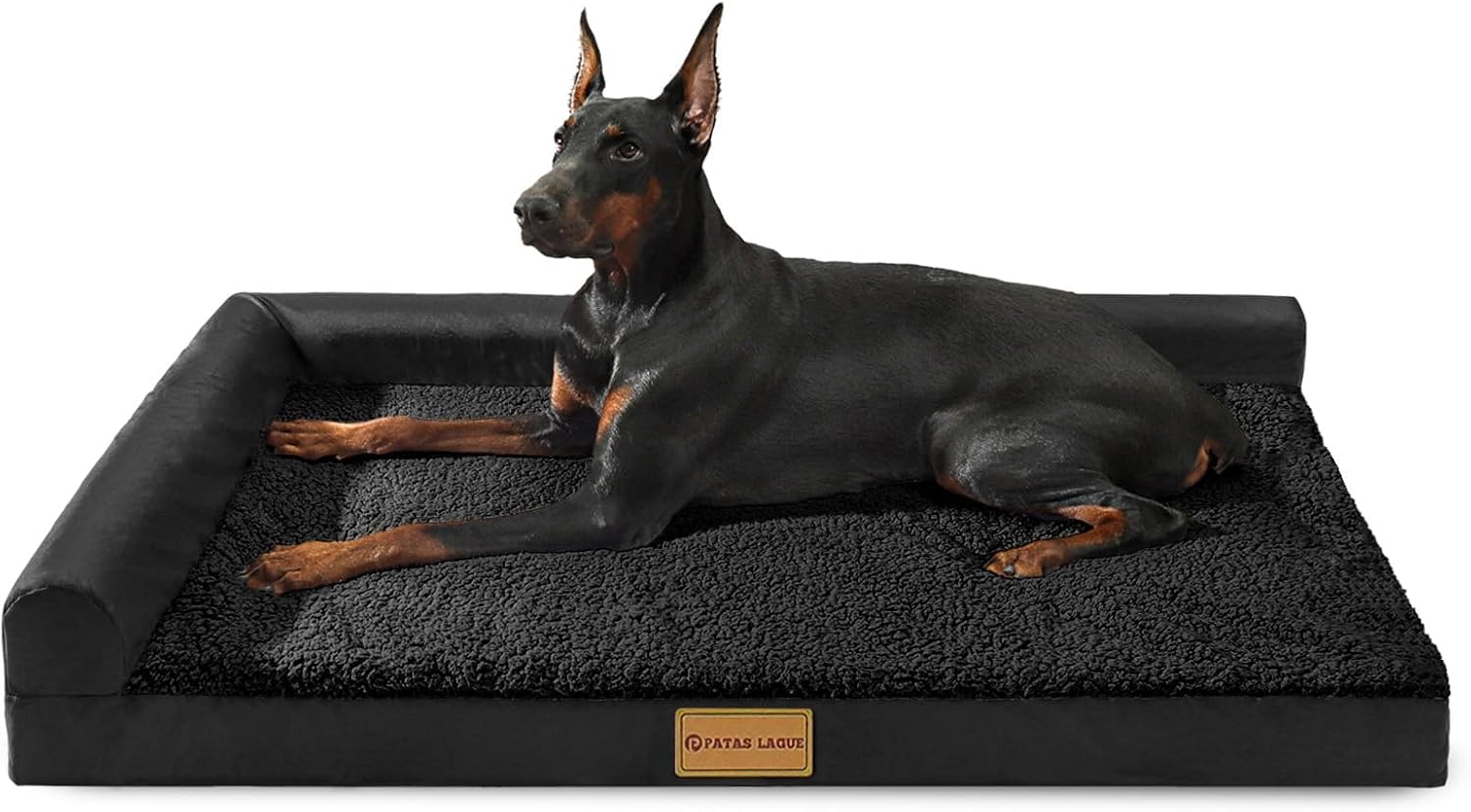
Budget pick: Patas Lague Orthopedic Large Dog Bed Washable Pet Sofa Bed 36''X24'' Black
 Visit on Amazon →
The first thing to notice is the footprint. Thirty-six by twenty-four inches is not a bed for a full grown golden. Biscuit lying flat is longer than that nose to tail, and he would hang off both ends. So treat this as what it is: a small washable sofa bed with a low bolster.
Where it earns its place is the supervised floor spot. The bed that sits next to your desk while you work, the second bed in a small room, or the travel bed that goes in the car and gets washed every week. Maple at 60 pounds curls up on a bed this size when she naps beside me, but she does not sleep the night on it.
The cover comes off and goes in the machine, and that is the feature I care about most. In my notebook, the beds that get retired early are almost never the ones with thin foam. They are the ones with a cover that cannot be washed, so the bed starts smelling like a dog and dies for a reason that has nothing to do with foam.
The word orthopedic on a bed this size is doing a lot of work. If you are buying this for a 90 pound golden with sore hips and expecting a real orthopedic bed, you will be disappointed, and I would rather say that now than have you find out in four months. Buy it as a cheap, washable, small spot for a dog who is still small or who is napping in the room with you.
Flaws but not dealbreakers: The bolster is low, so a golden who likes to rest his chin on a rim will slide off it. Biscuit ignores bolsters entirely and lies across the whole bed anyway.
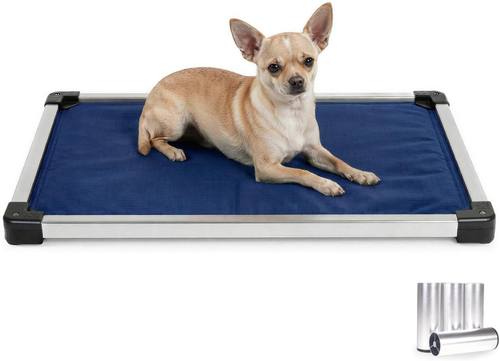
Upgrade pick: K9 Chew Proof Armored Padded Dog Crate Bed, S, Blue Quartz
 Visit on Amazon →
Size S is small, and I want to be blunt about it. This is not the pad for a 42 inch adult crate. It is the pad for a puppy crate or a small travel crate, and that is exactly the job where an armored, padded bed earns its money.
Here is the arithmetic that matters. A soft crate pad for a golden puppy lasts about as long as the puppy's patience, which is not long. You buy a flat pad, the puppy pulls the corner seam open, you come home to stuffing on the crate floor, and you buy another one. Three or four pads later you have spent more than the armored bed, and you still have a puppy with nothing to sleep on.
Armored means a tough outer shell with padding behind it, so teeth meet fabric that does not open at the seam. The padding is what makes it a bed rather than a liner. Blue Quartz is the color name, and the cover washes, which matters because a crate pad in a puppy crate gets washed constantly.
What I would check before ordering: measure the inside floor of your crate, not the crate's advertised size. Crate sizes are like dog bed sizes, which is to say they are optimistic. If the pad leaves more than an inch of bare floor on each side, the puppy will dig at the gap and pull the pad into a pile against one wall.
Flaws but not dealbreakers: You are paying for the shell, not the size. For a dog past the chewing stage, a plain washable pad in the right size is the better buy.
The actual setup workflow
Now the part you came for. This works for any large breed puppy, and it works for an adult golden who has already destroyed a bed or two.
Step one: Measure the dog while he is flat. Nose to tail, on the floor, relaxed. Add 8 to 12 inches. For a golden that lands you at 48 by 30 inches minimum for the main floor bed, and most adult goldens are happier at 50 by 36. A dog who has to curl tight to fit is not comfortable, he is just quiet about it.
Step two: Measure the crate floor, not the crate label. Tape measure inside the crate, both directions, corner to corner. Write the numbers on a sticky note and take it shopping with you. Half the crate pads I see returned were bought off the crate's advertised size.
Step three: Buy the crate bed first if you have a puppy. The crate is where the unsupervised chewing happens. A pad that survives the crate is worth more than a pretty floor bed, because the crate pad is the one your dog is alone with.
Step four: Place the floor bed where the dog can see the door. Goldens want a sightline. Biscuit's base of operations is the corner where he can watch the front door and the kitchen at the same time. Put the bed against a wall for back support and leave the front open.
Step five: Run the wash test on day one. Take the cover off before the dog ever sleeps on it. Wash it, dry it, put it back on. If the zipper jams or the fill clumps, return it while the return window is open. I do this with every bed that comes into this house and it has saved me a lot of money.
Step six: Check the foam every month. Press your palm flat into the middle of the bed and measure how far your hand sinks with a ruler. Write the number down. Two months later, do it again. If the sink depth grows by an inch, the foam is flattening and it is time to think about a better floor bed.
Step seven: Upgrade the floor bed when the dog is done growing. Puppy beds are temporary by design. Buy cheap while the dog is chewing and growing, then spend once at around 18 months when the skeleton is finished and the chewing has mostly stopped. That is the bed that has to hold up for two years, and that is the purchase where foam density matters.
Caveats, because I am not going to pretend otherwise. No bed replaces supervision for a determined chewer. If your dog eats fabric, take the pad out of the crate and talk to your vet about it, because an obstruction is a surgery, not a shopping problem. And if your golden is limping or stiff, that is a conversation with your vet, not a bed review. I was a vet tech, not a veterinarian, and joint stuff is for professionals.
The competition and why it lost
Donut beds look cozy and suit small dogs. Put a 90 pound golden on one and it becomes a pancake with a rim. Skip them for large breeds.
Cooling gel beds do work in a Colorado summer, but the cheap ones burst and leave gel on your floor. If you want one, buy from a brand that stands behind it, and expect to pay for that.
Deep foam beds in the $300 class are genuinely good, and they are the right answer for the adult floor bed you keep for years. Big Barker is the one I actually bought twice, and their warranty behavior in the golden community is real, they replace beds. That is a separate article, because a bed at that price is a decision you make once, not a piece of a puppy setup.
Furhaven is fine for what it is, but you are buying about 18 months of use, not a bed. Elevated cots handle chewers well and wash with a hose, and they belong in the summer and outdoor article.
The pattern across all of them is the same. Marketing words mean nothing until the spec sheet and the wash cycle prove them. A $40 orthopedic bed with 2 inches of foam is a mat, no matter how large the letters are on the box.
What this all costs
The armored crate bed costs more up front than the small sofa bed, and the small sofa bed costs less than almost anything else in the category. Neither number means much on its own.
Divide each one by the days it survives. A cheap pad that a puppy shreds in six weeks costs more per day than an armored bed that lasts three years. The small sofa bed is the cheap one, and it is cheap on purpose: it is the supervised spot, not the bed that has to hold a 95 pound dog every night for two years. The floor bed you buy at 18 months is the one where spending real money is worth it, because that bed has to hold its shape while your dog's hips rest on it for a third of his life.
The order is the whole trick. Crate pad first, washable small bed second, deep foam floor bed when the dog is grown. That sequence is cheaper than buying the expensive bed first and watching a puppy chew the corner off it.
Your dog sleeps 14 hours a day. That is more time on a bed than on anything else you will ever buy him. Measure once, wash it often, and replace on evidence instead of on a sale.